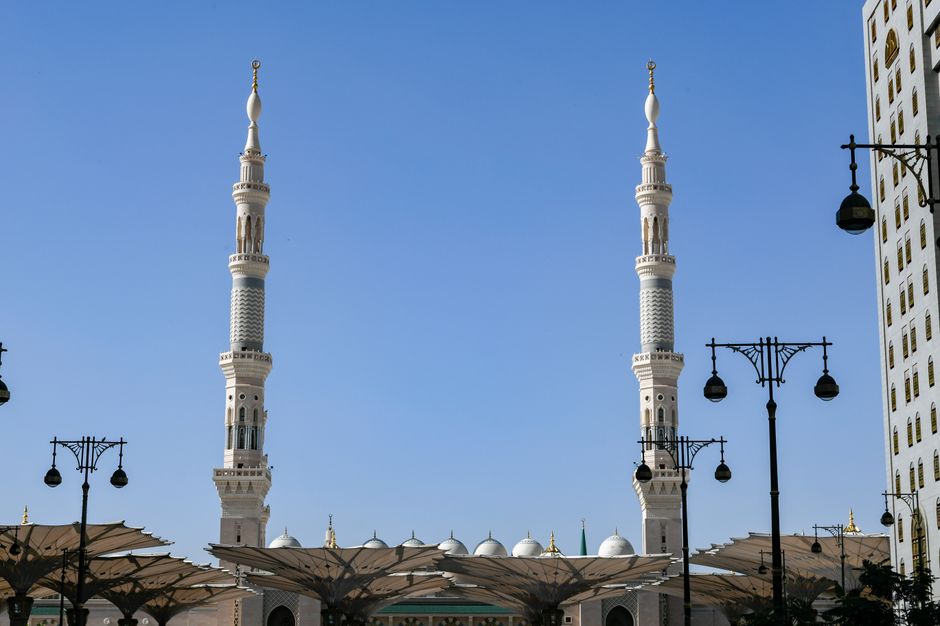
Medina is a religious and historical destination in western Saudi Arabia, combining ancient mosques, markets, mountain forts, and modern roads. This guide explains to the visitor what they can see and do, when to come, and how to travel and stay, based on the available information.
Overview of the city, its location, and its atmosphere
Medina, also known as the Prophet’s City, is the capital of the Medina region in the Hijaz region of western Saudi Arabia. It is about 400 km from Mecca to the northeast, about 150 km east of the Red Sea, and its nearest port is Yanbu port, located to its southwest at a distance of 220 km. The city’s area is about 589 km², of which 99 km² is occupied by the urban area, and the rest consists of mountains, valleys, flood slopes, desert and agricultural lands, cemeteries, and parts of the highway network.
The city was founded more than 1500 years before the Prophet’s migration, and was known before Islam as “Yathrib”, a name mentioned in the Qur’an. It is narrated in authentic hadith that the Prophet Muhammad ibn Abdullah changed its name from Yathrib to Medina. The city’s population is about 1,411,599 people.
Medina’s climate is dry desert, with little rainfall and high summer temperatures. Humidity is low for most of the year, averaging 22%, rising to 35% during rain periods, and dropping in summer to about 14%. It is generally affected by hot, dry southwesterly winds, with an average speed between 5 and 8 knots per hour.
Key landmarks and tourist sites
Al-Masjid an-Nabawi: The second holiest mosque for Muslims after Al-Masjid al-Haram in Mecca, and the most prominent landmark of the city. It is located in the heart of the urban area, with most hotels concentrated around it within the first ring road.
Quba Mosque: The first mosque built in Islam, and considered one of three of the oldest mosques in the world alongside Al-Masjid an-Nabawi and the Mosque of the Two Qiblas. Its location is within the city, and visiting it is a fixed part of the itinerary for visitors interested in Islamic history.
Mosque of the Two Qiblas: The third of the three ancient mosques in the city, and it is always mentioned together with Al-Masjid an-Nabawi and Quba Mosque as one of the oldest mosques in the world.
Al-Baqi’ Cemetery: The main cemetery for the city’s inhabitants, where many companions are buried. It is one of the sites visited by tourists as part of the tour of landmarks near Al-Masjid an-Nabawi.
Mount Uhud: Located north of Al-Masjid an-Nabawi, about 4 kilometers away, extending as a mountain range from east to west. It is named after the Battle of Uhud and is one of the city’s most important landmarks.
Mount al-Rumah: A small mountain located next to Mount Uhud, famous due to the incident of some archers disobeying the Prophet Muhammad’s orders in the Battle of Uhud. It can be seen along the same route that visitors use to visit Mount Uhud.
Mount Salaa: Located west of Al-Masjid an-Nabawi, about 500 meters away, it is about 1,000 meters long, 80 meters high, and roughly 500 meters wide, extending from north to south. Its proximity to the mosque makes it a short stop that does not require a long arrangement.
Mount Ayr: A black mountain with an almost straight summit, located south of the city and east of Wadi al-Aqiq, about 8 kilometers from Al-Masjid an-Nabawi.
Al-Jamawat Mountains: Three not large mountains located on the western side of the city along a section of Wadi al-Aqiq. They are among the natural landmarks that can be seen in the valley trail.
Mount Al-Raya: It was named this because the Islamic army was displayed there, and the banner was placed on it during the Battle of the Trench.
Mount Al-Aghwat: It was named this because the Aghwat bought it to take refuge from the people of Medina during the strife that occurred between them and the people of the city in the year 1117 AH.
Mount Quraiza: Also known as Volcano Mountain, and it is located in the southeast of the city.
King Fahd Complex for the Printing of the Holy Qur’an: The largest Qur’an printing press in the world. King Fahd bin Abdulaziz laid the foundation stone for the complex on October 23, 1982, corresponding to 5 Muharram 1403 AH, and officially inaugurated it on October 30, 1984, corresponding to 5 Safar 1405 AH. The complex annually produces an average of ten million copies, distributes them to Muslims on all continents, has produced more than 160 editions and 193 million copies of the Qur’an, and incorporates the most advanced printing technologies in the world.
Activities You Can Engage In
Activities in the city range from visiting mosques and historical landmarks, walking in markets, and viewing mountain vistas. Markets are spread throughout the city, including the Sultanah markets, Quba markets, Qurban markets, the International City market, Alia City markets, the Haram markets, alongside newly built malls such as Al‑Rashid Mall, Al‑Hasan Mall, and Al‑Noor Complex.
For those who prefer organized activities, specialized guided tourism experiences are available to explore the city’s historical and cultural depth. The city also includes many valleys, wells, streets, alleys, and old lanes suitable for quiet walking tours.
Best Time to Visit and Weather
Summer in the city is hot and dry, with temperatures ranging between 30° and 45 °C. Winter, on the other hand, is rainy, with the most rainfall occurring in April, and possible rain in December, January, and March, with average temperatures then ranging between 10° and 25 °C.
Practically, those who can tolerate high heat can visit in summer by scheduling outdoor activities during the cooler parts of the day, while those who prefer moderate temperatures will find the winter and spring months a suitable option, taking the possibility of rain into account.
Access, Transportation, and Accommodation
eading –>Restaurants and Local Food
The available sources do not specify particular restaurant names or local dishes in Medina. What can be said is that food options are practically linked to accommodation and shopping areas: markets such as Sultanah Market, Quba Market, and Haram Market, and malls such as Al-Rashid Mall, Al-Hasan Mall, and Al-Noor Complex. These are locations where visitors gather and where nearby food options can be found along the tour route.
Practical Tips for Travelers
- Medina is restricted to Muslims only, and this is a fundamental condition to be aware of before arranging your trip.
- Calculate distances in advance: Mount Uhud is 4 km north of the Prophet’s Mosque, Mount Sela is 500 meters west of it, and Mount Ayr is 8 km south of it.
- If the Prophet’s Mosque is your priority, choose accommodation within the First Ring Road, as most hotels are concentrated there.
- In summer, schedule mountain and outdoor tours during the coolest hours, and expect temperatures to reach 45°C.
- In winter and spring, bring rain protection, as April is the rainiest month.
- Allocate sufficient time for the King Fahd Complex for the Printing of the Holy Quran, as it is a large site with detailed content.
Frequently Asked Questions
Can non-Muslims enter Medina?
No, Medina is restricted to Muslims only.
How far is Medina from Mecca?
About 400 km to the northeast.
What are the oldest mosques in Medina?
Medina includes three of the world’s oldest mosques: the Prophet’s Mosque, Quba Mosque, and the Two Qiblas Mosque.
Where are hotels concentrated in Medina?
Most are in a closed circle around the Prophet’s Mosque within the First Ring Road.
Sources
- Medina — Saudi Tourism Authority (Ruh Saudi)
- Medina — Wikipedia
- Haramain High-Speed Train Enhances Investment Opportunities in Medina — Saudi Press Agency
- Public Transport System Provides Multiple Options and a Comfortable Experience for Visitors to Medina — Saudi Press Agency
- Ruh Medina Offers Specialized Guided Tour Experiences to Discover the Historical and Cultural Depth of Medina