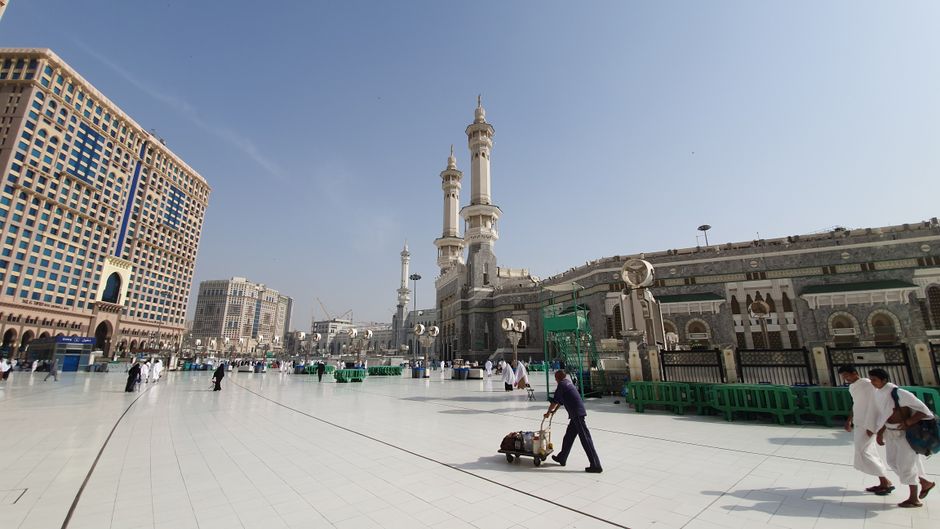
Makkah al-Mukarramah is a city visited by Muslims from everywhere, and it is primarily a religious destination, but it is also a city with its own geography, mountain landmarks, markets, and facilities serving the visitor. This guide gathers what you need to organize a visit: location and climate, main attractions, activities, access and accommodation, with practical tips based on documented information.
Overview of the city, its location, and its atmosphere
Makkah al-Mukarramah is the holiest city for Muslims, and it contains the Sacred Mosque and the Kaaba, which is the direction of prayer for Muslims. It is located in western Saudi Arabia in the Hejaz region, about 400 km southwest of Medina, about 75 km west of Ta’if, and about 72 km from Jeddah and the Red Sea coast. Its nearest port is Jeddah Islamic Port, and its nearest international airport is King Abdulaziz International Airport.
The area of Makkah al-Mukarramah is about 850 km², of which 88 km² is inhabited. The central area surrounding the Sacred Mosque covers about 6 km². Makkah’s elevation above sea level is about 277 meters, making it one of the lowest cities in the Hejaz region. The city lies in a valley of the same name, is divided into 34 neighborhoods, and its population, according to 2022 statistics, is about 2,385,509 people distributed across its old and new districts.
Most of Makkah’s rocks are very hard granite, and its location is among the most challenging geological formations. It has a hot desert climate like most cities of the Arabian Peninsula, with relative dryness due to its distance from the Red Sea coast.
Key landmarks and tourist sites in Makkah
The Sacred Mosque is the holiest place on earth for Muslims; it houses the Noble Kaaba, the direction of prayer for Muslims, and it is one of the three mosques to which travelers are drawn according to the Prophet Muhammad: “Do not set out for a journey except to three mosques: this mosque of mine, the Sacred Mosque, and Al-Aqsa Mosque.” Makkah also includes the sites visited by Muslims during the Hajj and Umrah seasons, namely Muzdalifah, Mina, and Arafat.
Jabal al-Nur is one of Makkah’s most prominent landmarks, and it contains the Cave of Hira where the Prophet Muhammad used to worship before his prophethood and where revelation descended. The mountain’s height is 642 meters and its area is about 5,250 m², and it was named Jabal al-Nur because of the appearance of prophetic lights within it.
Jabal Thawr is one of the central mountains of Makkah and one of its most prominent landmarks, and it contains the Cave of Thawr where the Prophet Muhammad and his companion Abu Bakr stayed for three nights during the migration to Yathrib. Its summit rises 750 meters, and it stretches from north to south for 4,123 meters.
Jabal Thabeer is a group of Makkah’s mountains connected to each other, located east of the Sacred Mosque, about four kilometers away, and it borders Mina to the northeast opposite Jabal al-Nur. Its height reaches 856 meters, and it was named after a man from the Banu Hudhail tribe named Thabeer.
Jabal Arafat is located about 20 kilometers east of the city and is one of Makkah’s most important landmarks; it hosts the most important Hajj rite, the Day of Arafat, on the ninth of Dhu al-Hijjah. Jabal Khundmah is situated in the southeast of the Sacred Mosque, extending longitudinally from north to south for more than 3 kilometers, with a height of 420 meters and a width in its middle sections of about 800 meters.
Jabal Abi Qubeis is located on the eastern side of the Sacred Mosque, and it was named so because a man called “Abu Qubeis” was the first to build on it; its height is about 420 meters. And Jabal Qa’iqan,
It is also called “Jabal Qarn”, located on the western side of the Holy Mosque and extending from Haret Al-Bab to Al-Qarara, with a height of about 430 meters. Jabal Al-Tarqi, located east of Mish’ar Mina, reaches 900 meters, making it the highest peak in the mountains of Mecca.
Jabal Omar is one of Mecca’s mountains, and large sections of it are currently being cleared to build a project that includes many hotels and residential units called the Jabal Omar Development Project, named after Omar ibn al‑Khattab.
Activities you can practice: family, nature, and heritage
For those looking for a family activity, Mecca has many public parks; there are about 476 parks covering a total area of 2 074 429 m², including 170 parks with children’s playgrounds. Among the most important are Al‑Masfalah Park, covering about 23 000 m² in the Al‑Masfalah district, Al‑Rasifah Park, and the Arabian Peninsula Park.
The most prominent natural activity is viewing mountain vistas. Around Mecca there are high points that offer wide views of the Holy Mosque, especially those in the Khunduma and Ajjad mountains, as well as some viewpoints in the Aziziyah neighborhoods. These sites provide panoramic scenes that reveal the movement of worshippers, the expanse of the Maṭāf courtyard, and the Haram’s plazas, attracting locals, visitors, pilgrims, and photography enthusiasts for panoramic shots.
The appeal of these sites increases at dawn, sunset, and night, when the lights of the Holy Mosque sparkle, reflecting the place’s spirituality. Culturally, attention turns to Mecca’s cultural cafés, which are part of an integrated experience industry that enhances tourism and quality of life.
Best time to visit and weather in Mecca
Mecca’s climate is hot desert; temperatures rise sharply in summer, reaching around 47 °C in June. In winter, Mecca stands out from other Arabian Peninsula cities with a mild climate, with temperatures ranging from 25 °C during the day to 17 °C at night.
Rainfall is most common in November, December, and January, with an annual total between 25 and 80 mm. Winds blow from the north, northwest, and southwest, with average speeds of 3 to 36 knots. Humidity is moderate for most of the year, averaging between 32 % and 57 %.
Getting to Mecca, transportation, and accommodation
The nearest international airport to Mecca is King Abdulaziz International Airport, and the closest port is Jeddah Islamic Port, making Jeddah the natural gateway for those heading to Mecca. Taif lies about 75 km to the west, and Medina about 400 km to the southwest.
Regarding accommodation, Mecca’s hospitality sector is expanding; the Jabal Omar Development Project includes many hotels and residential units. Additionally, the “Masar Mall” project within “Masar Destination” in Mecca offers an integrated experience for visitors and pilgrims, with a variety of global brands, a wide range of restaurants, as well as dedicated spaces for families, seniors, and recreational and cultural facilities.
Restaurants, local food, and Mecca’s markets
Mecca’s economy mainly relies on selling goods and products to the city’s residents, pilgrims, and visitors
Thus, central markets and shopping centers are abundant there. This makes shopping a practical part of the visit, whether to buy supplies or gifts.
Regarding food, the “Masar Mall” project offers a wide range of restaurants that cater to various tastes, along with spaces dedicated to families and the elderly. Details about local kitchens and popular dishes have not been officially announced in the available sources, and visitors can rely on the restaurant options available in the shopping centers and areas surrounding the Haram.
Practical Tips for Travelers to Mecca
- Check the weather before traveling: Summer is very hot and temperatures in June can reach around 47°C, while winter is warm during the day and mild at night.
- Take into account the rains of November, December and January, and humidity ranging between 32% and 57% for most of the year.
- If you are a photography enthusiast, plan to reach the overlooking heights shortly before dawn or just before sunset, as these times are the most attractive for panoramic views.
- For family visits, gardens such as Al‑Masfalah Garden and Al‑Rasifah Garden provide open spaces, and some gardens include playgrounds for children.
- Rely on Jeddah as an air or sea entry point; it is the closest to Mecca via King Abdulaziz International Airport and Jeddah Islamic Port.
Frequently Asked Questions about Visiting Mecca
How far is Mecca from Jeddah?
Mecca is about 72 kilometers from the city of Jeddah and the Red Sea coast, and about 75 kilometers from Taif to the west.
What is Mecca’s elevation above sea level?
Mecca’s elevation above sea level is about 277 meters, making it one of the lowest cities in the Hejaz region.
What is the highest mountain peak in Mecca?
Mount Al‑Tarqi, located east of Mish’ar Mina, reaches an elevation of 900 meters, and is the highest peak in Mecca’s mountains.
Where can you see a panoramic view of the Grand Mosque?
Among the most prominent locations are the heights in the Khandaq and Ajiyad mountains, and some viewpoints from the Al‑Aziziyah neighborhoods.
Sources
- Mecca — Saudi Tourism Authority (Saudi Spirit)
- Mecca — Wikipedia
- Cultural Cafés in Mecca — Saudi Press Agency
- Tourism Minister Sponsors Signing of the “Masar Mall” Financing Agreement — Makkah Newspaper
- Mountain Views in Mecca — Sayidaty Magazine
- Parks in Mecca: Ideal Atmosphere and High Attendance from Residents