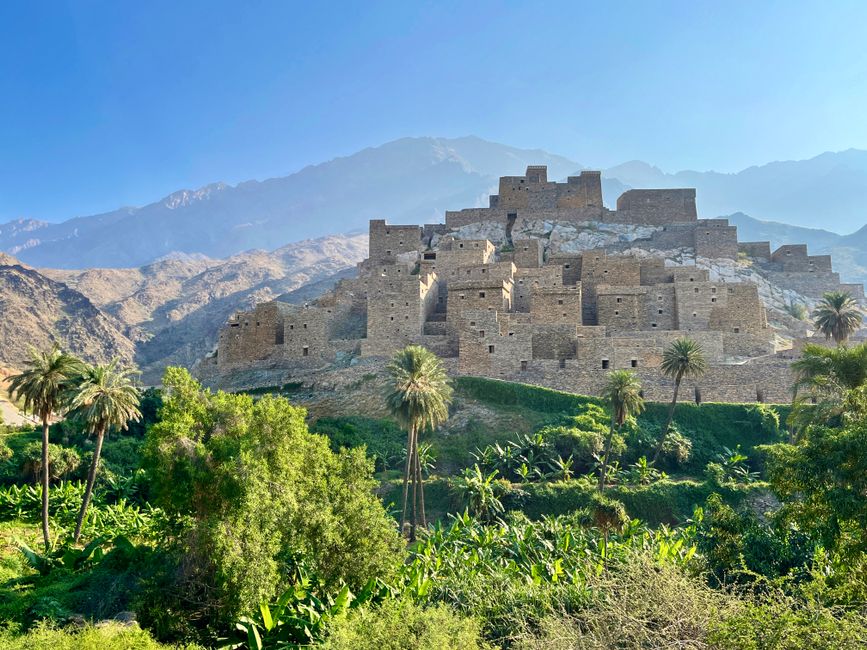
Al-Baha is a mountainous city in southwestern Saudi Arabia, known for its dense forests and mild summer climate, and for its old stone villages still perched on the mountain slopes. This guide gathers the highlights of what can be visited there, when to go, how to get around, with practical details taken from available sources.
Overview of the city, its location and climate
Al-Baha is the capital of the Al-Baha region and the seat of the emirate, and is considered one of Saudi Arabia’s most important tourist and agricultural cities, to which the region is attributed, and it concentrates the administrative and commercial weight. Al-Baha’s population is approximately 90,515 people, and it hosts government departments, major commercial centers, and popular markets, the most important of which is Thursday Market.
It is bordered to the north by Al-Qara’ governorate, to the west by Al-Mandaq and Al-Makhwah governorates, to the south by Baljurashi governorate, and to the east by Al-Aqiq governorate. The city is surrounded by several forests, including Ragdan Forest, Al-Shahba Forest, Dar Al-Jabal, Al-Zarqa, and Wadi Fiqq.
The climate is affected by the varied terrain. The Hejaz sector is exposed to moist air fronts coming from the Tihama plain, forming clouds and fog, and it often experiences fog in winter with thunderstorms, lower temperatures, and heavy rain, while it enjoys a mild, breezy climate in spring and summer. The Tihama sector, however, has a climate different from that of the Hejaz.
Key attractions and tourist sites in Al-Baha
Ragdan Forest is located 4 km northwest of Al-Baha city, on the edge of a cliff that offers wide views down the cliff and into the valley, and overlooks the “Al‑Uqba” road that connects Al-Baha with Al-Makhwah governorate. The trail from it heading north leads to the adjacent Zarayeb Forest and other places such as Umdan Forest in the Daws Mountains, passing by wadis, dams, villages, and elevations, with rest areas and stops for taking photos, feeding wildlife, and buying from wandering honey sellers, and one can see remains of ancient forts such as Al‑Kamil fort.
Zarayeb Forest is located in the northwest of Al-Baha city, about 10 km from the city center, and the road from it heading north leads to the neighboring Khayra Forest.
Khayra Forest is a large branching forest that extends from a high cliff and connects southward to Zarayeb Forest. It is abundant with agricultural terraces that retain water as a reservoir after rainfall and are supplied by Khayra Waterfall or “Bir al‑Qilt”, a waterfall that descends into a rock‑surrounded pool and was formerly a main water source for local residents. The forest isمن البحر الأحمر.
Village of Dhi Ayn an old village on the top of a white mountain, known for cultivating bananas, lemons, peppers, basil and kadi, and some of its local residents sell handmade products to visitors. It can be reached from Al-Baha heading southwest towards the Al-Baha pass with its 34 tunnels, up to the Dhi Ayn fortress which overlooks directly the Rash Valley with its buildings stacked on the mountain top and its view over a green orchard of palm trees and banana trees.
Bin Raqoush Archaeological Palace is located in the village of Bani Sar north of Al-Baha city, and its construction dates back to 1834 AD, and it was a complete residential complex consisting of several family homes and a guesthouse headed by the council (Zahran).
Jabal Shada Al-A’la is located in the Makhwah Governorate in the Al-Baha region of southwestern Saudi Arabia, and its height is about 2,200 meters above sea level, making it one of the highest mountains in the area. The surrounding area is a land for mountain climbing enthusiasts and a natural reserve for the endangered Arabian leopard.
Ein Al-Jamal Waterfall is located in the village of Al-Shabriqa, and it is a waterfall that flows from the mountain tops into the valley, and it is part of Prince Mishari bin Saud Park which features its agricultural terraces for water storage.
Elephant Road is 45 minutes from the center of Al-Baha city, north of Al-Aqiq Governorate near the regional airport. It is a historic road linked to the story of Abraha Al-Ashram who attempted to demolish the Kaaba, and it suggests the strength that allowed paving stones over long distances to facilitate the passage of elephants given the volcanic terrain (harraat) that hinders movement.
Activities you can do: family, nature, and heritage
The activities here vary depending on the location. In the forests, walking on trails, stopping at rest areas to take photos, feeding wild animals, and buying from wandering honey sellers, as in the Ragdan Forest trail. In the Mehran Forest you can descend on foot among the trees and ascend in the evening, which is a suitable experience for those who want a walk inside the forest.
For those who prefer a heritage vibe, visiting old villages such as Al-Mald and Dhi Ayn allows you to see stone buildings, forts, and watchtowers, and in Dhi Ayn you can purchase handmade products from local residents. As for climbing enthusiasts, the Jabal Shada Al-A’la area is a dedicated land for mountain climbers.
For families, Sultan bin Salman Park near Mehran Forest overlooks the cliff, and Prince Mishari bin Saud Park includes the Ein Al-Jamal Waterfall and agricultural terraces, and the Jabal Athrib cable car offers a different experience by descending from the mountain heights to the plains of Tihama.
Best time to visit and weather
The Hejaz sector in Al-Baha features a mild, cool climate in spring and summer, and this period is most suitable for those who want relatively cool weather away from heat. In winter, the Hejaz area experiences clouds and fog due to air masses coming from the Red Sea, along with thunderstorms, lower temperatures, and heavy rain.
Therefore it is useful to plan the visit such that spring and summer are for long trips between forests and villages, and winter for those who want to see fog while being prepared for rain and cold. The Tihama sector, however, has a different climate from the Hejaz sector, which is an important distinction for those descending from the mountains to the plains via cable car or obstacles.
Access, transportation, and accommodation
/wp:heading –>Access to landmarks within the area relies on mountain roads. Raghadan Forest is 4 km northwest of the city, Azraib Forest is 10 km from the city center, Mehran Forest is 2 km to the south, and Al-Malad Village is 3 km to the south on the Baljurashi Road. The Fil Road is 45 minutes from the city center, north of Al-Aqiq Governorate, next to the regional airport. These short distances make car travel practical between several sites on the same day.
Some of the roads themselves are part of the experience, such as the Baqaa Pass with its 34 tunnels leading to Dhi Ain Village, and the “Al-Uqba” Road connecting Al-Baha to Al-Makha, which can be viewed from the cliffs of Raghadan Forest. For accommodation, the Qamara Mountain Resort has opened in the area, a new tourist destination embracing the nature of Al-Baha.
Restaurants and Local Food
Al-Baha is an agricultural region, and this is reflected in what you find in its markets. Al-Khamees Market is one of the most important popular markets in the city and is a suitable place to get to know local products and the handicrafts that characterize the region. In Dhi Ain Village, the village is famous for growing bananas, lemons, peppers, basil, and kadi, and handmade products can be purchased from local residents there.
Along the forest trails, roaming honey vendors are widespread, a local product that can be purchased while traveling between sites. Since many visits take place in forests and parks, it is practical to coordinate your meals in advance according to your location, especially as some sites are far from the city center.
Practical Tips for Travelers
- Calculate distances before setting off: some sites are very close to the city center (Mehran 2 km, Al-Malad 3 km, Raghadan 4 km), while the Fil Road requires 45 minutes from the center.
- Allocate time for the roads themselves, as passes and mountain routes like the Baqaa Pass and the “Al-Uqba” Road are part of the scenery, not just a means of transport.
- Take into account the fog and rain in winter, especially in the Hijaz section, and wear clothing suitable for the drop in temperature.
- In Mehran Forest, walk down between the trees and ascend in the evening, so plan your time to return before dark.
- Carry cash to buy honey from roaming vendors and handmade products from local residents.
- If you are a climbing enthusiast, Mount Shada, the highest peak, is a well-known destination for this activity, with an elevation of approximately 2,200 meters.
Frequently Asked Questions
When is the weather in Al-Baha mild?
In spring and summer, as the region is characterized by a mild climate, while winter sees fog, heavy rain, and a drop in temperature in the Hijaz section.
Which forest is closest to the center of Al-Baha city?
Mehran Forest is only 2 km to the south, followed by Raghadan Forest 4 km northwest of thef=”https://www.visitsaudi.com/ar/see-do/destinations/al-baha”>Al-Baha — Saudi Tourism Authority (Ruh Al-Saudiya)