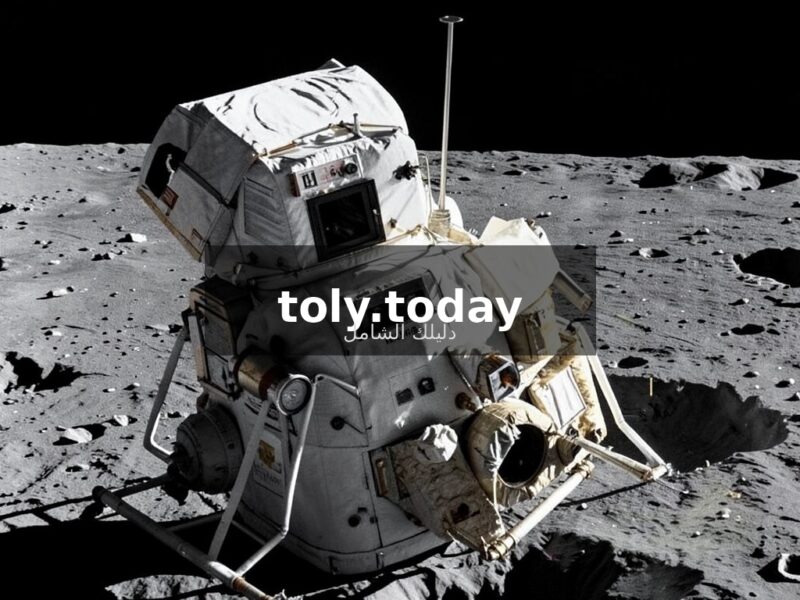
On this day, July 14, 1965, humanity achieved an unprecedented milestone in space exploration. The American probe Mariner 4 (Mariner 4) became the first spacecraft in history to capture close-up images of Mars, shattering the veil of mystery surrounding the “Red Planet” for thousands of years.
An 8-month journey
Mariner 4 launched from Cape Canaveral in Florida on November 28, 1964, aboard an Atlas-Agena rocket. The probe traveled an immense distance of approximately 325 million kilometers through space to reach Mars after a journey lasting 228 days. The probe carried a primitive television camera—with a resolution of just 200 × 200 pixels—and scientific instruments to measure the magnetic field, charged particles, and space dust.
22 minutes that changed everything
On July 14, 1965 (U.S. time, with closest approach at dawn on July 15 GMT), Mariner 4 passed within 9,844 kilometers of Mars. Over just 22 minutes, the probe captured 22 images of the Red Planet and recorded them on magnetic tape. Due to the probe’s weak signals, transmitting each image to Earth took more than 8 hours—meaning the images continued arriving for days!
The shock: A dead world and volcanic craters
As the images began reaching mission control at NASA’s Jet Propulsion Laboratory (JPL), scientists were on the edge of their seats. The first image revealed a surface pockmarked with craters—resembling the Moon—rather than the water channels and life many had imagined. Instead of the canals and habitable conditions speculated by 19th-century astronomers, the images showed a barren, desolate world that appeared lifeless.
This moment drastically altered humanity’s view of Mars. Before Mariner 4, many believed Mars might be habitable, with dark lines on its surface possibly being water channels. The first images shattered this myth, showing that Mars—at least in the photographed region—resembled the Moon more than Earth.
Groundbreaking scientific discoveries
Mariner 4’s contributions went beyond images. Its scientific instruments revealed that:
- Mars has little to no magnetic field
- The Martian atmosphere is extremely thin—with a surface pressure of just about 30 millibars (compared to 1,013 millibars on Earth)
- The atmosphere consists of roughly 80% carbon dioxide
- Surface temperatures were far colder than previously believed
Mariner 4’s legacy
After its successful mission, Mariner 4 continued orbiting the Sun. Contact was lost forever on December 21, 1967. Yet its legacy endured—paving the way for all subsequent Mars missions, from Viking to Curiosity, and from Perseverance to the UAE’s Hope probe. Every high-resolution image of Mars you see today owes its existence to those 22 faint black-and-white photos received in the summer of 1965.
Frequently asked questions about Mariner 4
How many images did Mariner 4 capture of Mars?
It captured 22 images during its 22-minute flyby of Mars. These images covered only about 1% of the planet’s surface.
Why did it take so long to transmit the images?
Because the data transmission rate was extremely slow—just 8.33 bits per second. Due to the vast distance between Earth and Mars, sending each image took about 8 hours.
Were Mariner 4’s images the first ever taken of Mars from space?
Yes, Mariner 4 was the first probe to capture close-up images of Mars and transmit them back to Earth. It was the first time humans had ever seen the surface of another planet up close.
What happened to Mariner 4 after its mission?
After its Mars flyby, the probe continued in a solar orbit. It was struck by a series of micrometeoroids, and contact was lost permanently on December 21, 1967. The spacecraft remains in a solar orbit to this day.
Are there any color images from Mariner 4?
No, the camera only captured black-and-white images.
Colored lights were not available in spacecraft at that time.