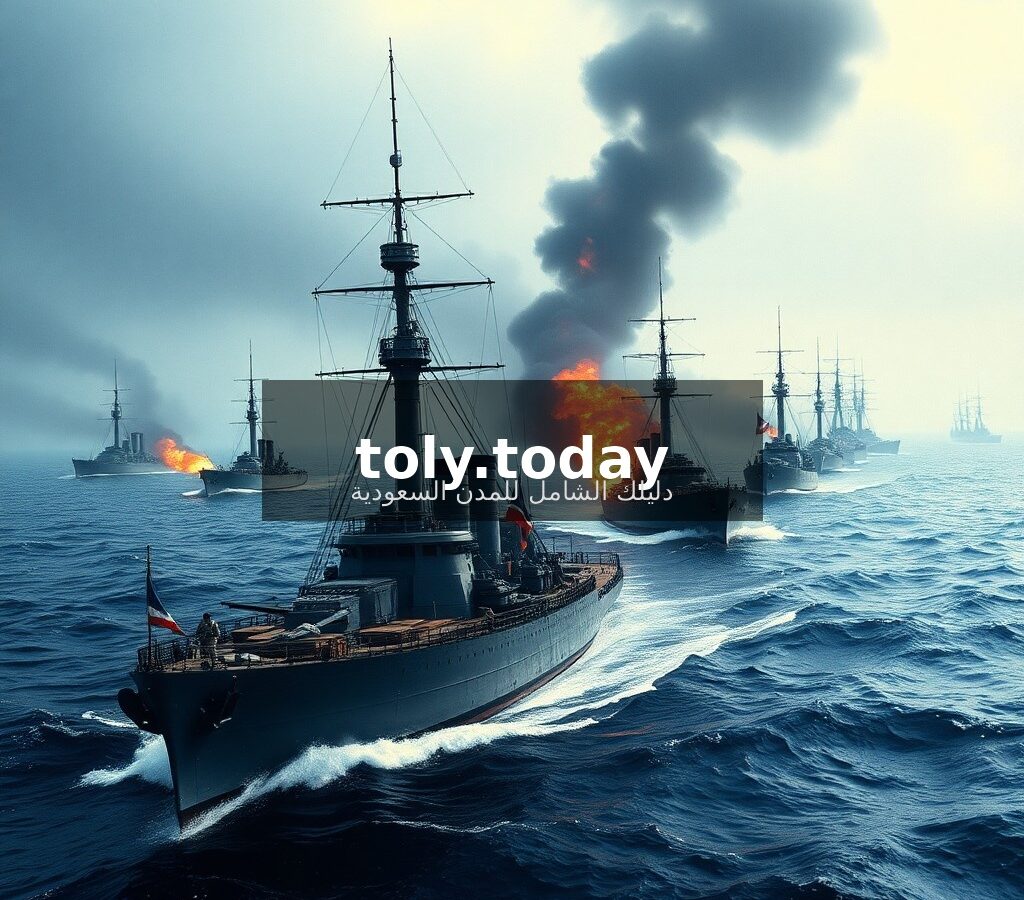
On this day in 1905, one of the greatest naval battles in modern history began. The Battle of Tsushima took place in the Tsushima Strait between the Yellow Sea and the Sea of Japan, where the Japanese fleet under the command of Admiral Heihachiro Togo met the Russian Baltic Fleet coming from Europe after a seven-month journey. The battle ended with the near-total destruction of the Russian fleet, in a crushing defeat that changed the balance of power in East Asia.
Historical Background
The Russo-Japanese War broke out in February 1904 due to colonial competition between the two empires for influence in Manchuria and Korea. Japan started the war with a surprise attack on the Russian fleet in the port of Port Arthur (now Lushun). After months of fighting, Japan managed to blockade the Russian ships in the port and cut off their supply lines.
In a desperate attempt to turn the tide, Tsar Nicholas II decided to send his Baltic Fleet — located in the Baltic Sea near European Russia — on an epic 33,000 km (18,000 nautical miles) journey across the Atlantic, Indian, and Pacific Oceans to reach the Russian port of Vladivostok in the Far East.
The Long Journey and Early Problems
The Russian fleet — consisting of 38 ships under the command of Admiral Zinovy Rozhdestvensky — set sail from the Baltic ports on October 15, 1904. However, the journey began with a diplomatic disaster: in the Dogger Bank incident in the North Sea, Russian ships mistakenly fired on British fishing boats, thinking they were Japanese torpedo boats. The incident almost sparked a war with Britain, and was only avoided by a Russian apology and financial compensation.
The fleet continued its journey along the western coasts of Africa, then around the Cape of Good Hope, and on to Madagascar, where it stopped to refuel. There, Rozhdestvensky received news of the fall of Port Arthur to the Japanese, making his original mission — to lift the siege of the port — impossible. Nevertheless, the Tsar ordered him to continue advancing towards Vladivostok.
Battle Details
On the morning of May 27, 1905, Japanese scout ships spotted the Russian fleet approaching the Tsushima Strait. Admiral Togo was waiting for them, having set a trap. At 1:40 pm, Togo raised his famous signal: “The fate of the Empire depends on this battle. Every man must do his utmost”.
The Japanese ships outperformed the Russian ones in speed and armament. Togo executed the famous “Crossing the T” maneuver, allowing his ships to fire all their guns at the Russian ships while the Russian ships could only respond with their forward guns. Admiral Rozhdestvensky was severely injured in the early stages of the battle and lost consciousness, leaving the fleet without effective command.
By sunset, four Russian battleships had sunk. With the onset of night, Japanese destroyers and torpedo boats attacked the remaining Russian ships in one of the first successful nighttime battles in naval history. On the morning of May 28, Admiral Nikolai Nebogatov surrendered with what was left of the fleet.
Consequences and Casualties
| Side | Killed | Wounded | Prisoners | Sunk ships | Captured ships |
|---|
| Japan | 117 | 583 | — | 3 torpedo boats | — |
| Russia | 5,045 | 803 | 6,016 | 21 ships | 7 ships |
Russia lost all 11 of its battleships — seven sunk and four captured. Only a few ships survived: one cruiser and just two destroyers reached Vladivostok. Japan, on the other hand, did not lose any major warships, and its human losses were relatively light. Military historians described it as “the greatest naval battle since Trafalgar”.
Global Implications
The defeat at Tsushima had massive repercussions:
- End of the war: Russia was forced to surrender and negotiate the Treaty of Portsmouth in September 1905, with mediation by U.S. President Theodore Roosevelt.
- Rise of Japan as a great power: This was the first time in modern history that an Asian nation defeated a major European power in a full-scale war, inspiring liberation movements across Asia and Africa.
- Russian Revolution of 1905: The military defeat exposed the weakness of the Tsarist regime and fueled internal unrest, paving the way for the 1917 revolution.
- Naval lessons: The battle demonstrated the importance of speed, heavy armament, and wireless communications in naval warfare, and changed warship design for decades to come.
Quick Facts
- It was the first major naval battle where wireless telegraphy (radio) was used decisively for command and control.
- The Russian ships traveled 33,000 kilometers in 7 months — the longest military sea voyage in history at the time.
- It was the last naval battle fought between fleets of modern ironclad battleships.
- The Japanese battleship Mikasa — the flagship — is still preserved as a museum ship in Yokosuka, Japan.
- After 340 years since the Battle of Fukuda Bay (1565), this was the first time Japan defeated a major European power in a decisive naval battle.